
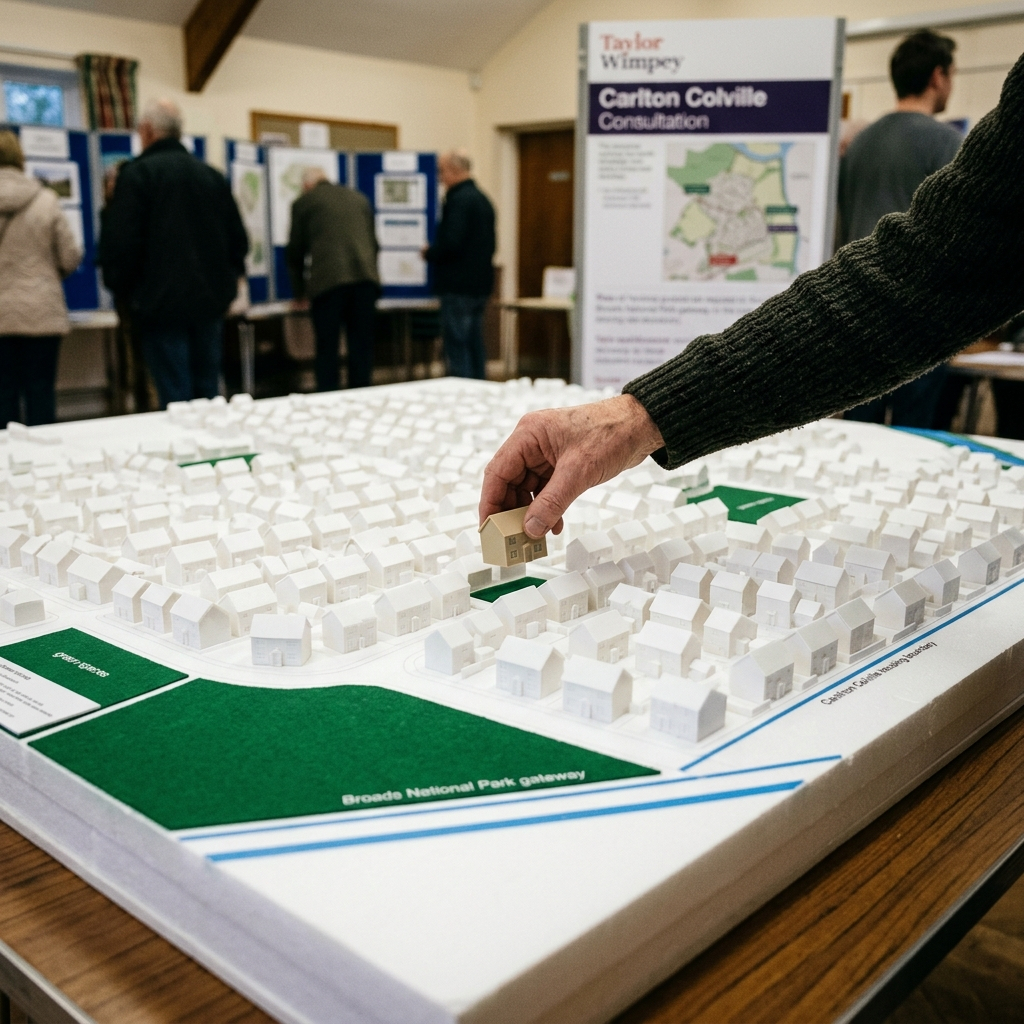
I've watched this pattern unfold across dozens of development proposals. A major housebuilder announces plans. They promise green spaces, cycle paths, and biodiversity enhancements. They schedule public consultations months before submitting anything formal. They tick every box on the modern planning checklist.
Then you look at the numbers.
Taylor Wimpey wants to build 450 homes in Carlton Colville, a town with a population of 8,439. If each home houses two people, that's a 12% population increase. Not gradual growth. Not organic expansion. A single development adding more than one in ten residents to an existing community.
I'm not against housing. I'm against the fiction that we can bolt nearly half a thousand homes onto a town and call it "thoughtfully planned" without addressing the infrastructure question honestly.
Taylor Wimpey has scheduled two public exhibitions. June 10th at Uplands Community Centre, 3pm to 6pm. June 13th at East Point Pavilion, 12pm to 3pm. Letters have gone out to nearby residents. The developer won't submit the outline planning application until Autumn 2026.
That's an exceptionally long pre-application period.
On the surface, it looks like exemplary community engagement. In practice, I see something else. I see a developer who knows this proposal will face serious opposition and wants to smooth the path before formal scrutiny begins. The consultation isn't about whether this development should happen. It's about refining the proposal enough to survive the planning process. There's a difference.
Public exhibitions serve a purpose. They allow residents to voice concerns. They create a paper trail showing the developer "listened." But they don't fundamentally alter the commercial logic driving the project. Taylor Wimpey isn't going to walk away because residents worry about GP capacity, the increase in traffic. They're going to document the concern, propose a mitigation strategy, and proceed.
I've seen this before. Community consultation has become a box-ticking exercise, not a genuine negotiation about whether large-scale development fits a community's capacity.
The proposal includes enhanced walking and cycling connections, public green spaces, a sustainable drainage system, a destination play area, a new gateway into the Broads National Park, native habitats, and biodiversity enhancements.
It mentions exploring an Early Years facility. Here's what it doesn't address: GP surgeries, schools, the increased traffic on the roads, public transport, sewerage capacity or any of the essential infrastructure that 900 additional residents will need.
The statement acknowledges "real concern about infrastructure and increased pressure on GP surgeries and local services." It acknowledges the concern. It doesn't answer it.
The pattern repeats in similar in similar developments. Developers promise green spaces and cycle paths because those fit neatly within their site boundaries. They can design them, build them, and hand them over. Infrastructure outside the development boundary becomes someone else's problem.
Carlton Colville's existing GP surgeries already serve 8,439 people. Add at least 900 more and you need proportionally more appointments, more doctors, more practice and pharmacy space. Who provides that? Not Taylor Wimpey. Not automatically. The developer might pay a Section 106 contribution towards healthcare infrastructure. But those contributions rarely cover the full cost of expanding services. They're negotiated down during planning discussions. They're spread across multiple priorities. They arrive years after the homes are occupied.
Meanwhile, new residents move in and discover they can't get a GP appointment for three weeks.
The Early Years Facility Tells You Everything. Taylor Wimpey mentions they're "currently exploring with East Suffolk Council and Suffolk County Council" the need for an Early Years facility. Notice the language. Not "we're providing." Not "we're committed to." Exploring the need.
This tells me several things. First, the developer recognises that 450 family homes will generate demand for childcare. Second, they haven't committed to providing it. Third, they're negotiating with councils about who pays for it.
In a nutshell, everyone knows the need exists. Nobody wants to fund it. The developer wants to minimise costs. The council has limited budgets. The result is vague language about "exploring" and "potential" facilities.
I don't blame Taylor Wimpey for this. They're operating within a planning system that allows them to build homes without proportionate infrastructure investment. I blame the system that makes this possible. If you're going to increase a town's population by 12%, you need 12% more school places, 12% more healthcare capacity, 12% more road capacity, 12% more sewerage capacity. You can't offset that with a fancy new crossing, play area and some cycle paths.
The proposal promises "new native habitats and biodiversity enhancements" plus a "new gateway into the Broads National Park." These aren't optional extras. They're planning requirements. Modern developments must demonstrate biodiversity net gain. They must show environmental benefits. They must align with local plan policies about green infrastructure. I'm not dismissing the value of these features. Green spaces matter. Native habitats matter. But I'm tired of seeing them presented as generous community benefits when they're actually regulatory compliance.
Taylor Wimpey will plant trees and create wetland areas because planning policy requires it. They'll design a gateway to the Broads because it strengthens their application. These features serve the development's approval, not primarily the community's needs.
The sustainable drainage system? That's to prevent the development flooding neighbouring properties, which would create legal liability. It's not altruism. It's engineering necessity. There's a lot of flooding there, so drainage and building on a flood plain needs to be addressed.
I want to separate genuine community benefits from things developers would do anyway. When we conflate the two, we lose sight of what's actually missing from these proposals.
Autumn 2026 for outline planning submission. That's more than two years from the initial public exhibitions. Large developments take time. I understand that. But this extended timeline serves a strategic purpose. It allows Taylor Wimpey to engage with objectors, refine the proposal, and build relationships with council officers before anything formal begins.
By the time the application lands on the planning committee's desk, much of the opposition will have been heard, documented, and addressed through minor design changes. The proposal will look reasonable. It will have incorporated feedback. It will be harder to refuse.
This is sophisticated planning strategy. It's not sinister. It's professional. But it means the public consultation phase isn't a neutral information-gathering exercise. It's the first stage of a campaign to secure approval. Residents attending the June exhibitions should understand this. Your feedback will be recorded. Some concerns will be addressed through design tweaks. Others will be acknowledged but not resolved. The fundamental question of whether Carlton Colville can absorb 450 new homes won't be on the table.
Carlton Colville had 8,439 residents in 2021. That's the baseline everyone's using to calculate the 12% population increase. But census data tells you more than population. It tells you age distribution, employment patterns, housing tenure, and infrastructure usage. I haven't seen Taylor Wimpey's demographic analysis, but I can guess what it shows.
According to the ONS Census data, Carlton Colville's demographic makeup is heavily defined by its history. Over the last few decades, 2,364 homes were bolted onto the original village. The Carlton Colville Neighbourhood Plan explicitly notes the fallout of those developments reporting that they became isolated "dormitory estates." Residents predominantly work and socialise outside the area, create severe peak-hour traffic at the Bloodmoor Hill roundabout, and putting immense strain on local services because no physical cohesion or infrastructure was built with them.
Taylor Wimpey’s target market for 450 mixed, modern family homes will inevitably skew toward young working families and commuters. They'll attract first-time buyers, young families, and people relocating for work. That means more children needing school places. More working-age adults commuting. More cars. More demand for childcare.
The existing population of Carlton Colville includes retirees, established families, and long-term residents. Their infrastructure needs differ from those of 900 new residents moving into a new development.
A 12% population increase doesn't translate to a uniform 12% increase across all services. Schools might need 20% more capacity. GP surgeries might need 15% more. Roads might need 25% more capacity during peak hours.
I don't see this nuance in the developer's statement. I see a generic promise of "thoughtfully planned" development without the granular infrastructure analysis that would make that claim credible.
The question I would ask is where will 900 new residents work? If they commute, what happens to the surrounding road network during rush hour? Where will their children go to school? Are there surplus places in Carlton Colville's existing schools, or will this require expansion or new provision?
What's the sewerage capacity? Can the existing treatment works handle a 12% increase in wastewater? The Environment Agency has officially classified East Anglia as a "Serious Water Stressed Area" a designation reserved for regions where available water resources are maxed out and standard demand threatens to permanently outstrip supply. Because of this acute crisis, Essex and Suffolk Water recently activated powers under the Water Industry Act 1991 to enforce compulsory smart water meters across our homes. Existing residents have no choice. They are told that water is a precious resource. As a result they are being fitted with hourly digital tracking networks to find every dripping tap, to monitor their daily habits. Yet, while the community is being legally squeezed to conserve every drop, the planning system simultaneously tolerates a proposal from Taylor Wimpey to plug 450 brand-new homes into this exact same stressed network.
Then there's the electricity grid, what's the capacity? Modern homes use more power than older properties, especially with electric vehicle charging and heat pumps.
What's the public transport provision? If there isn't adequate bus service, every household will need at least one car, probably two. Intensifying rush-hour congestion on the A146 and local choke points.
These are the questions that determine whether a development integrates into a community or overwhelms it. They're technical. They're boring. They don't make good consultation display boards. But they matter more than the play area design.
If you attend the public exhibitions, don't focus on the design of the play area or the species mix in the biodiversity zones. Focus on infrastructure.
Ask specific questions:
What's the projected impact on GP appointment availability? What Section 106 contributions are proposed for healthcare infrastructure? What's the school capacity analysis? What traffic modelling has been done? What sewerage capacity assessment exists? What electricity grid reinforcement is planned? What public transport improvements are included?
Demand written answers. Verbal reassurances at a public exhibition don't bind anyone. Written commitments in planning documents do. Ask when infrastructure will be delivered relative to housing occupation. There's no point having a new GP surgery funded if it opens five years after the homes are occupied.
Ask about enforcement mechanisms. If Taylor Wimpey commits to infrastructure provision, what happens if they don't deliver? What penalties apply? Who monitors compliance?
Britain needs more housing. Carlton Colville might be a reasonable location for growth. I'm not arguing against development in principle. I'm arguing against the pretence that you can add 450 homes to a town without proportionate infrastructure investment.
The current system allows developers to build homes and leave infrastructure gaps for councils and residents to manage. It allows vague promises about "exploring" facilities instead of binding commitments. It allows biodiversity enhancements to be presented as community benefits when they're regulatory requirements.
We need a different model. One where infrastructure delivery is tied to housing occupation. Where Section 106 contributions fully fund the services new residents need. Where planning approval is conditional on demonstrable infrastructure capacity.
Until we have that, we'll keep seeing developments like Carlton Colville. Thoughtfully designed on paper. Inadequately supported in practice. Leaving existing residents to absorb the strain on services while new residents discover the infrastructure they expected doesn't exist.
The public exhibitions in June are your opportunity to make this point. Not with anger. Not with blanket opposition to housing. But with specific, documented questions about infrastructure capacity and binding commitments to address gaps.
Taylor Wimpey will listen. They'll record your concerns. They'll refine the proposal.
Whether they'll actually solve the infrastructure problem is another question entirely.
And that's the question that matters most.