
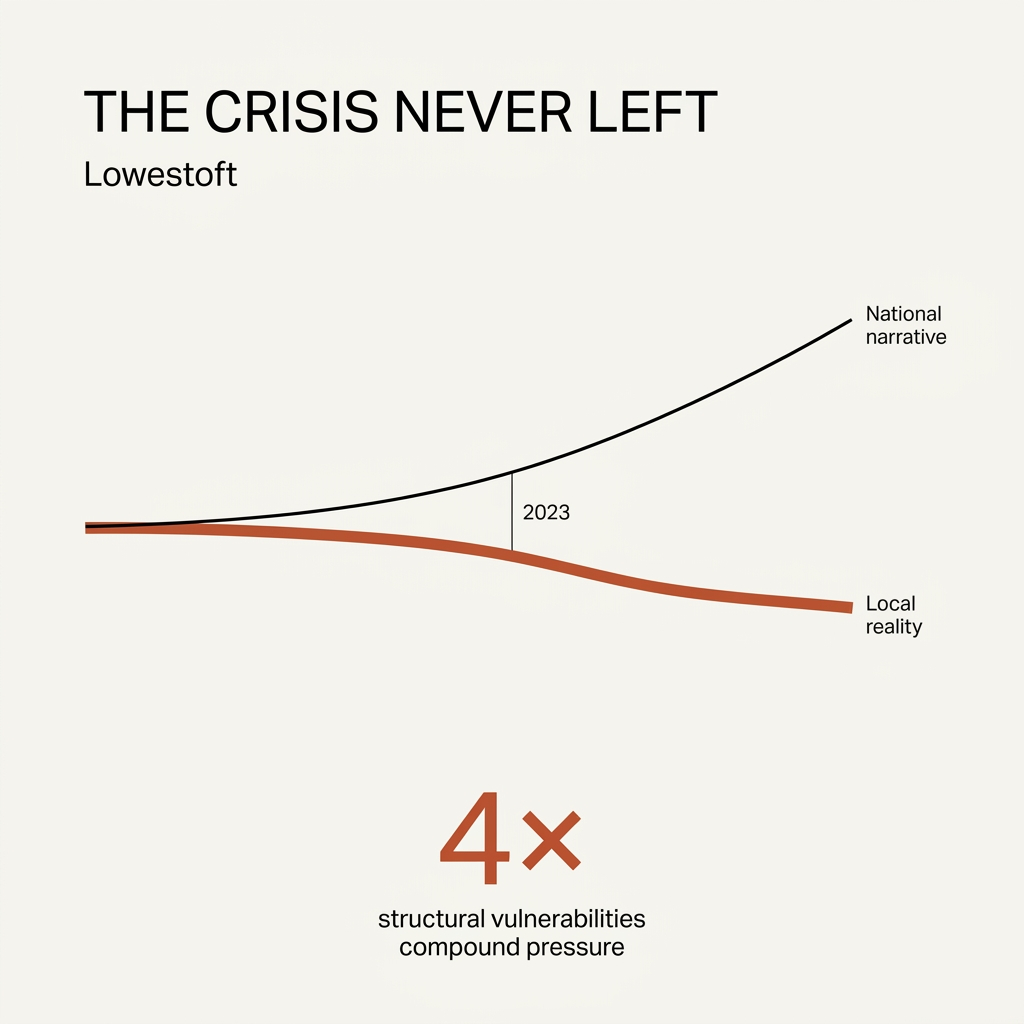
It just became less visible in the national conversation.
Across the country, analysts are again warning about pressure on household finances. Energy bills remain a concern. Food prices have not returned to anything like normal for many families. Fuel costs continue to shape everyday decisions for anyone who relies on a car or van to get to work, school, appointments or the supermarket.
But in towns like Lowestoft, the bigger question is not whether the economy looks better on a spreadsheet or in a glossy report. It is whether people can actually feel that improvement in their weekly shop, their petrol tank, their energy bills and most importantly their bank account.
For the tradesperson filling up before a job in Ipswich, the pensioner watching the heating, the single parent pricing up school shoes, or the family cutting back the last week before payday, the crisis does not feel like something that ended.
The national conversation may have moved on.
Lowestoft has not.
So why does Lowestoft Feel the squeeze more sharply?
Cost of living pressures do not land evenly across the country. A rise in fuel, food or energy costs might be described nationally as a percentage increase. But locally, the impact depends on income, transport, housing, age, health, work and access to services.
Lowestoft has several pressures that make national price rises harder to absorb. Car dependency is one of them.
There has been some welcome movement in the right direction.
Recent improvements to train times and bus connections at Lowestoft railway station are a good start. Earlier and later rail services can make a real difference for students travelling to college, commuters trying to get to and from work, and visitors who want to spend more time in Lowestoft or Beccles before heading home.
Better bus links from the station also matter. They make it easier for people arriving by train to reach the seafront, attractions, nearby villages and local businesses without needing a car.
That is good for residents. It is good for visitors. And it is good for pubs, restaurants, theatres, shops and attractions that depend on people being able to get into town and stay later.
But it also raises a bigger question.
If better transport links can reduce pressure on households, support students, help workers and bring more visitors into the local economy, why stop there?
In a town where fuel costs hit so many people directly, public transport is not just an environmental issue. It is a cost of living issue.
Every reliable bus route, every later train, every better connection and every affordable ticket gives people more choice. More choice means less dependence on the petrol pump. And less dependence on the petrol pump means more resilience when fuel prices rise again.
Public transport does not work equally well for everyone, especially in rural communities around the town. For households in places such as Carlton Colville, Kessingland, Pakefield, Oulton Broad, Corton and the wider Waveney area, a rise at the petrol pump can quickly become a weekly budget problem. For these communities driving is not a luxury. It is how they get to work, reach medical appointments, visit family, take children to activities, and access shops or services that may not be nearby.
When fuel goes up, it does not just affect commuters. It affects care workers, tradespeople, delivery drivers, small businesses and families who have no realistic alternative to using a vehicle.
Wages are another issue.
Lowestoft is not London. It does not have London wages, London transport links or London job density. A national rise in living costs hits differently in a town where many households are already working with less disposable income.
A £40 or £50 monthly increase in bills might be uncomfortable for one household and devastating for another. The percentage increase may be the same, but the pain is not.
Then there is the age profile of the town.
Lowestoft has many older residents, including pensioners on fixed incomes. They cannot simply negotiate a pay rise, work overtime or switch jobs to absorb higher costs. When bills rise, they often have fewer options. For some, the decisions become painfully practical. Heat the whole home or just one room. Use the car less or miss out on activities. Buy the usual food shop or downgrade again.
One of the problems with national economic language is that it can make recovery sound more complete than it feels.
Inflation falling does not mean prices are falling. It usually means prices are rising more slowly than before.
If food, energy and fuel costs have already climbed sharply, a slower rate of increase does not magically restore household budgets. Families are still paying more than they were before. They may simply be paying more at a slower pace.
That is why some national headlines can feel disconnected from local reality. A report may say confidence is improving. A minister may say pressure is easing. A graph may show inflation moving in the right direction.
But none of that automatically means a family in Lowestoft has more money left after rent, mortgage payments, council tax, food, energy and fuel.
The question is not just whether the national economy has improved.
The question is whether people here can feel any breathing space.
For many, the answer is still no.
Cost of living pressure does not stop with individual households. It moves through the local economy.
When fuel prices rise, businesses that depend on transport face higher costs. Tradespeople pay more to reach jobs, their price to the customer increases. Delivery costs increase. Rural households feel the impact quickly.
When energy bills rise, families cut back elsewhere. That might mean fewer café visits, fewer takeaways, fewer small purchases, fewer trips out, or putting off repairs to the house and maintenance on the car.
That matters because local businesses also operate on tight margins. An independent café, small shop, local service provider or self-employed tradesperson does not need every customer to disappear to feel the strain. They only need enough people to spend less often.
Households cut back. Businesses feel it. Hours become tighter. Hiring slows. Confidence drops.
It becomes a cycle.
There may be no dramatic collapse. No single moment when the town visibly changes. Just fewer treats, fewer repairs, fewer outings, more unpaid bills, more people asking for help at foodbanks and more businesses wondering where the footfall has gone.
That is the hidden story behind the cost of living squeeze.
It is not just about prices.
It is about what those prices are removing from everyday life.
Money stories can become cold very quickly.
Percentages. Forecasts. Price caps. Inflation rates. Consumer confidence surveys.
Those things matter, but they are not the whole story.
Behind every number is a household making decisions.
A parent delaying a school uniform purchase.
A pensioner turning the heating down.
A worker wondering if a longer commute is still worth it.
A small business owner absorbing costs they cannot pass on.
A family cancelling something that used to make life feel normal.
These are the details that matter locally, because this is where national policy becomes real.
It becomes real at the petrol pump.
It becomes real at the checkout.
It becomes real when the direct debit leaves the account.
It becomes real when someone opens an energy bill and feels their stomach drop.
The mistake in the national conversation is treating the cost of living crisis as if it had a neat beginning, middle and end. For many households, it has not ended.
It has changed shape.
This is a coastal town with surrounding rural communities, car-dependent households, older residents, working families, small businesses and people already stretching wages further than they should have to.
A national recovery figure does not automatically put money back in people’s pockets.
A falling inflation rate does not undo years of higher prices.
A government announcement does not tell us whether a pensioner in Pakefield, a parent in Carlton Colville, a worker in Oulton Broad or a business owner in the town centre is coping.
National figures can tell part of the story.
For many people in Lowestoft, the cost of living crisis did not end.
It simply stopped making headlines.