
There was a time when a Lowestoft haunting knew its place.
It stayed in the cold corner of the room. It creaked along the landing after midnight. It appeared briefly in the mist near the Scores, or waited politely at the foot of your bed like any respectable East Anglian ghost.
But something has changed.
Across Britain’s oldest towns, and especially in places like Lowestoft where salt air, old brick, maritime tragedy and centuries of human life sit layered together, the unexplained appears to be modernising.
The ghost in the hallway has discovered Wi-Fi.
The phantom footsteps have found Bluetooth.
And whatever is lurking outside your front door at 3:17am may no longer need to knock.
It can simply trigger your Ring doorbell.
The 3am Notification
Imagine the scene. You are asleep in an old Lowestoft property, perhaps a narrow cottage tucked near one of the historic Scores, a former fisherman’s home close to the Denes, or a converted building where the floorboards have been witness to more horror than the current occupants ever will.
The street outside is silent. No cars. No voices. Just the faint breath of the North Sea moving through the town.
Then your phone lights up.
Motion detected at your front door.
You open the app. The camera loads. The night-vision view flickers into life.
Nothing is there.
No fox. No teenager cutting through the alley. No neighbour coming home late.
But the doorbell camera is still tracking movement.
A faint distortion crosses the frame. Not a person exactly. Not an animal. More like a shimmer, a ripple in the air, sliding along the path with the strange confidence of something that knows the house better than you do.
Then it passes straight through the wall to your home.
The camera briefly pixelates.
Your Wi-Fi drops.
And somewhere downstairs, a smart speaker wakes up and says:
“I’m sorry. I didn’t catch that.”
The problem, of course, is that nobody spoke.
In recent years, a new type of haunting has started to appear in online forums, paranormal circles and late-night conversations between people who insist they are “not usually into this sort of thing.”
The old signs are still there: cold rooms, strange knocks, items moving, the feeling of being watched.
But the new reports are different.
Smart speakers activating in empty rooms.
Voice assistants responding to questions nobody asked.
Security cameras detecting human movement where there is no human being.
Digital baby monitors crackling with voices that do not belong to anyone in the house.
Smart lights turning on by themselves, then appearing as “manual activation” in the app even though the occupants are asleep.
One Lowestoft resident, who asked not to be named because “people will think I’ve lost it,” described waking at 4:36am to hear their smart speaker playing what sounded like “old radio chatter under water.”
Not music. Not a podcast. Not a recognised station.
Just a broken voice, distorted by static, repeating something that sounded like a name.
When they checked the app the next morning, there was no playback history.
Another household claimed their doorbell camera captured a figure at the gate, only for the footage to vanish from the cloud archive minutes later. The app retained the notification. The video itself was gone.
Perhaps the most chilling account comes from a Lowestoft resident. For years, his family had experienced the standard things you get in an old place. Keys would go missing only to turn up right where he’d already checked, and the floorboards would creak in the dead of night. It was casual stuff really, nothing that made him think he had a proper haunting on his hands.
That complacency went right out the window while they were away on holiday down in Cornwall.
They were sitting at dinner with their baby girl when his phone buzzed in his pocket with a motion alert from the nursery monitor app back home. Knowing the house was locked up tight and completely empty, he opened up the live feed to see what had tripped the sensor.
What he was seeing was enough to turn your blood cold. In the middle of the pitch-black nursery, where absolutely nobody was supposed to be, the lens had picked up a strange mist. And the truly terrifying part was that if you squinted at the pixelated image, the vapor seemed to be shaping itself into the unmistakable build of a small child standing right by his daughter's empty cot.
Lowestoft is not a town built yesterday. It is a place of fishermen, sailors, press gangs, war, shipwrecks, industry, poverty, prosperity, loss, storms and witch trials. Its historic streets have seen generations come and go, while the same bricks, beams and staircases remain.
For years, traditional hauntings were explained through familiar folklore, but now there is a newer theory.
And it is far stranger.
The Digital Stone Tape Theory
The original Stone Tape Theory became popular in the 1970s. It suggested that buildings could somehow “record” intense emotional events, especially where materials such as stone, brick, flint, iron, timber and damp foundations were present.
Under certain conditions, those recordings might “play back.”
Not an intelligent ghost, perhaps. Not a spirit trying to communicate. More like an echo.
A woman forever crossing a landing.
A child crying in a room where no child sleeps.
Footsteps repeating the same route every night.
Now imagine that same idea dragged into the digital age.
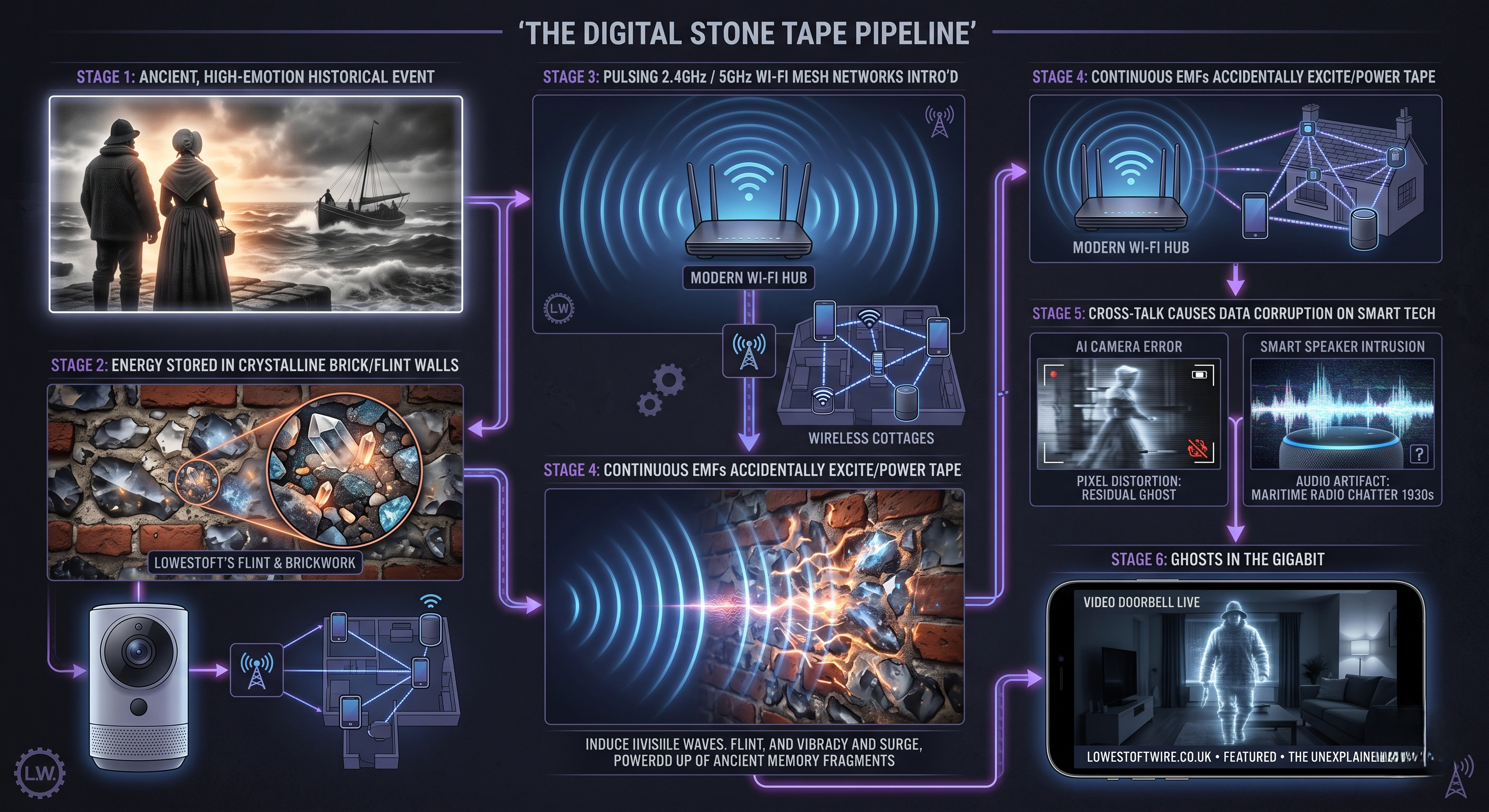
By packing our historic homes with pulsing radio frequencies, like 2.4 GHz and 5 GHz Wi-Fi networks, smart hubs, and signal boosters, we have introduced a massive, permanent influx of electromagnetic energy. Modern researchers argue that these artificial fields are actively exciting the atoms within the old stonework, essentially acting as a continuous power supply for those dormant, ancient energy imprints.
The tech isn't necessarily encountering a sentient spirit; instead, the digital grid is accidentally reading the "stone tape" and translating that raw energetic discharge. The camera doesn't see a ghost its reading a residual EMF. The smart speaker isn't talking to the dead; the dead are bleeding into the device's audio receiver. We haven't left Lowestoft's history behind by modernising.
It looks like we’ve just given it a new way to communicate.
The sceptic says this explains everything: interference, compression artefacts, weak Wi-Fi, faulty sensors, dodgy firmware updates, insects triggering cameras, or sound misheard through poor speakers.
The believer says we may have accidentally plugged our haunted houses into the mains.
Are Smart Devices Detecting the Dead?
Paranormal investigators have long used electromagnetic field meters, audio recorders and infrared cameras in an attempt to detect unusual activity. The difference now is that millions of ordinary homes contain devices that constantly monitor movement, sound, temperature, light and presence.
In other words, the average smart home has become a low-budget ghost-hunting kit.
Your video doorbell watches the doorstep.
Your smart speaker listens in the kitchen.
Your motion sensors scan the hallway.
Your thermostat notices sudden drops in temperature.
Your camera software tries to identify a “person” from a blur of pixels.
So what happens when something old, faint and difficult to explain passes through that digital net?
Perhaps the camera does not see a ghost.
Perhaps it sees a human-shaped error.
A compression glitch caused by something the software was never designed to understand.
Perhaps the smart speaker is not speaking to the dead.
Perhaps it is receiving fragments of sound, interference, or something stranger - old voices dragged through a modern receiver and spat back into the room at 3am.
If residual hauntings are emotional recordings, then coastal towns should be full of them.
The farewell at the door.
The family listening for bad news.
The sailor who never came back.
The storm that changed everything.
Now place a smart speaker in the corner of that room.
Connect it to the internet.
Leave it listening through the night.
And when it suddenly crackles awake with something that sounds like a distant transmission, it becomes harder not to wonder whether the past is finding a new frequency to communicate.
Of course, there are rational answers.
Smart speakers can mishear sounds and activate accidentally. Doorbell cameras can be triggered by moths, rain, fog, headlights, reflections, cats, spiders or shifting shadows. Wi-Fi problems can corrupt footage. Apps can mislabel events. Automated lights can behave strangely after updates or power fluctuations.
Sometimes a ghost is just a router in need of a reboot.
But that's not going to make you feel any better when your phone says there is someone outside at 3:00am, and the camera shows an empty path, and then the motion tracker follows something you cannot see.
Lowestoft Wire makes no official recommendation that readers throw their Alexa into the sea, unplug their router, or sleep with a saucepan on their head to block spiritual Wi-Fi signals.
However, for those living in older properties, there may be a few warning signs worth noting:
Your smart speaker answers questions nobody asked.
Your doorbell detects motion at the same time every night.
Your lights switch on in rooms nobody has entered.
Your camera briefly shows a figure, but the recording later fails.
Your devices lose connection whenever the room turns cold.
Your baby monitor picks up voices, singing, or breathing when there is no one nearby.
Your smart TV turns itself on to a blank screen.
Or worst of all, your voice assistant suddenly says:
“Playing The Best of 1930s Maritime Radio.”
The unnerving thought is that technology may be making it easier to hear and see the past.
For centuries, Lowestoft’s old houses have kept their memories and secrets. The knocks in the walls, the draughts on the stairs, the fleeting movement in the corner of the eye these were easy to dismiss.
Now the house has cameras.
Now the hallway has sensors.
Now the kitchen is listening.
And perhaps the past, patient as ever, has simply found a new way through.
So tonight, before you go to bed, you might check the doors. You might close the curtains. You might tell yourself that old buildings make noises and smart devices glitch.
And you would probably be right.
Probably.
But if your phone lights up at 3:00am with a motion alert from the front door, and the app says someone is standing outside…
Maybe take a moment before opening the live feed.
Because in Lowestoft, the old ghosts may not be knocking anymore.
They may already be connected in your home.